
Blog Post
This blog was authored by Dr. Simon Marmura Brown, Strategic Director, UNB’s Pond-Deshpande Centre
Unlocking Capital Where It’s Needed Most
Today, Catalyst Community Finance is releasing a report we’ve collectively spent several months working on: the economic case for community finance in Canada. To give readers more context, I wanted to say a little about what it is and how it came together.
This work started with the team at Catalyst Community Finance. I got to know them through this project, and through them found myself in working groups with people from all over the country: people thinking hard about a different kind of financing for nonprofits, community organizations, charities, and for all the sectors et people in our economy who struggle to access capital from traditional lenders. I hadn’t fully appreciated, until I was in those rooms, just how many people across Canada are quietly working on this. There are many, and there is already a real ecosystem (approximately $7.35 billion in community-directed capital) built almost entirely without the federal architecture that supports similar systems in other countries.
The eco-system’s conviction, which quickly became my own, is that we don’t have to reinvent the wheel. So much of what works has already been built and tested in other places: tax-credit models that pull in about $8 of private capital for every $1 of public cost in the U.S., and as much as $20 to $1 in Québec. We can look at what they’ve done and implement it. It isn’t a bulletproof solution, but it starts to move the needle.
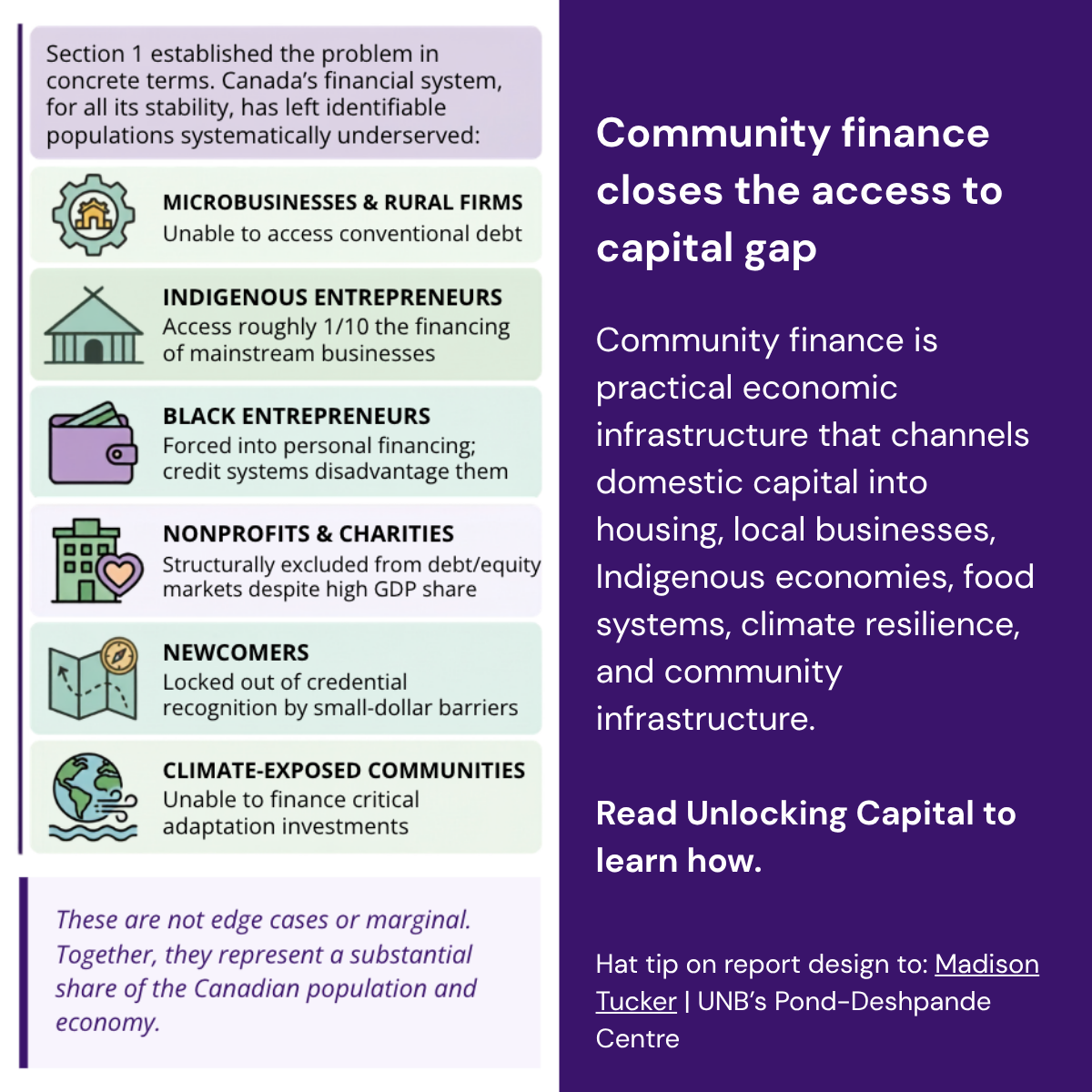
The needle is worth moving. It unlocks capital for very productive parts of our economy: our nonprofits et charities deliver 8.2% of federal GDP, more than oil and gas, yet are largely shut out of conventional lending. It opens up capital to people who face barriers to accessing it, for example, Indigenous entrepreneurs who access only about a tenth of the financing available to comparable businesses. Moreover, where these tools have been tried, they work… One newcomer micro-loan program we examined returned more than $3 in economic activity for every public dollar it used and had a repayment rate of 98%.
That’s really what this report tries to do. It shows the long history of Canadians inventing et proposing new ways to organize our economic lives et livelihoods. We are one of the countries who are richest in experiments, however, over the years, our federal architecture hasn’t kept up.
The five policy proposals we’ve put forward would, very clearly, benefit exactly the people who need those benefits most. Our own modelling suggests that just one of them—a $250 million fund to capitalize community finance institutions—would generate around $523 million in economic output, add $301 million to GDP, and support nearly 4,000 jobs.
I’m looking forward to what comes next: catalyzing growth in our communities and in our country.
Follow Along
To learn more about these conversations and to receive updates, subscribe to the Pond-Deshpande Centre’s Newsletter, here.
