
Authors: Sydney Campbell, Herb Emery
In New Brunswick, where a student lives matters for learning outcomes. Education is often described as an equalizer of economic opportunity, but evidence from PISA tells us a different story. These results show that geography has an important association with literacy outcomes and life opportunities. For many students in smaller, often rural communities, they are falling behind their city peers in literacy outcomes.
Across Canada, and especially in the Atlantic provinces, literacy gaps exist between smaller and larger communities. These gaps are not simply about schools. They reflect broader differences in opportunities, resources, and community environments.
New Brunswick youth already have lower average reading performance compared to their peers outside of the Atlantic region on PISA assessments, and within New Brunswick, students outside of the province’s three largest cities perform even worse on the PISA assessment1.
PISA 2022 data highlights that all across Canada, as community size increases, from rural areas to small towns to major cities, student reading skills improves. This pattern holds across reading, mathematics, and science, but is especially concerning in reading. This is not a new phenomenon. Earlier research from Statistics Canada using PISA from 2000, found that urban students outperform rural students in reading2. This data tells us that both then and now, the smaller the community, the greater the disadvantage.
New Brunswick and Atlantic Region
This rural disadvantage is even more pronounced in Atlantic provinces. The report highlights that performance gaps between New Brunswick and the Atlantic region are widest in rural areas and narrow as communities become more urban3. In New Brunswick, students attending schools in areas with fewer than 3,000 people consistently score lower on the PISA reading assessment than their peers in larger urban centers, and lower than their peers in smaller communities in western Canada4.
While the reasons for the poorer PISA literacy scores remain to be identified, several possible reasons include that schools in smaller communities lack resources available to schools in larger communities with larger enrolments and scale economies for supports and programming. They may have fewer specialized programs or teachers with particular specializations in key subject areas. The infrastructure of these schools may also be lacking, with an absence of particular facilities or even adequate facilities, such as computer labs. Additionally, recruiting and retaining educators can be more challenging in rural areas5. These constraints can shape the day-to-day learning experience of students, dictating what and how students can learn.
Geography is closely tied to socioeconomic conditions, which further influence literacy outcomes. Literacy development is not confined to the classroom. It is shaped by the broader environment, such as the home and the community, in which students grow up6.
Students in rural areas are more likely to grow up in communities with higher rates of adult unemployment, lower household income, lower educational attainment, and fewer parental educational resources. In other words, the parents or guardians of these students are more likely to be unemployed, have a lower level of education achieved, be low income, and have less educational resources like books in their home. In many rural communities, there are fewer visible pathways that connect education to future opportunities. Over time, this can influence motivation, aspirations, and ultimately, achievement. These factors matter.
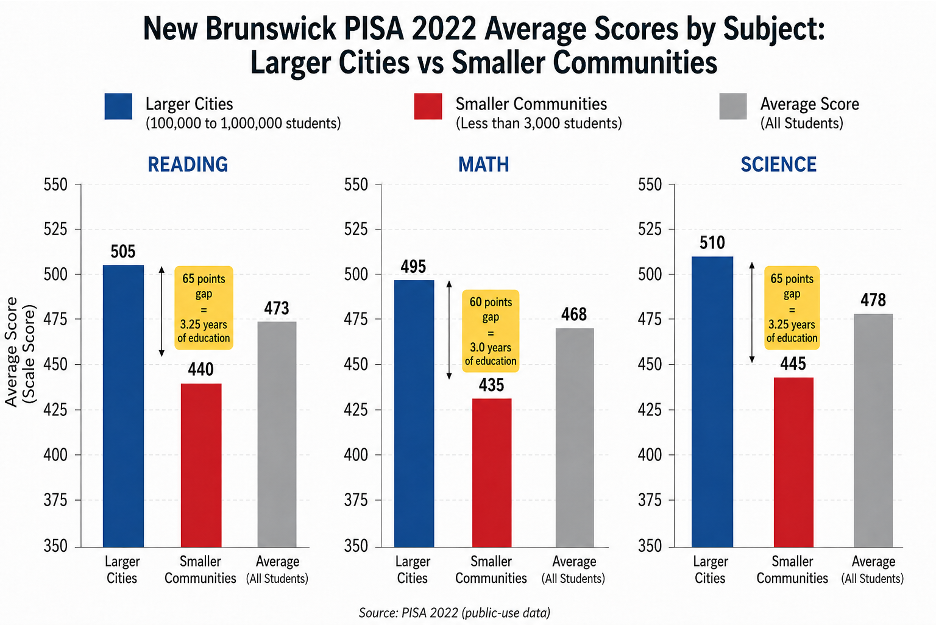
The geography of literacy in New Brunswick reveals that where students grow up shapes their access to resources, their exposure to opportunities, and their expectations for the future. Students in rural areas may be navigating structural disadvantages rooted in geography and community context. Without addressing these spatial inequalities, gaps in literacy – and life outcomes – will persist.
What’s next in this series:
The inequalities do not stop there. Other dimensions of a student’s identity – such as gender and socioeconomic status – are associated with their literacy outcomes, and consequently, their future opportunities.
References
1 Tramonte, L., Emery, H., & Baker, S. (2025). ACA Presentation Summary Report. University of New Brunswick.
2 Cartwright, F., & Allen, M. K. (2002). Understanding the rural-urban reading gap (1, p. 73). Statistics Canada.
3 Tramonte, L., Emery, H., & Baker, S. (2025). ACA Presentation Summary Report. University of New Brunswick.
4 Tramonte, L., Emery, H., & Baker, S. (2025). ACA Presentation Summary Report. University of New Brunswick.
5 Cartwright, F., & Allen, M. K. (2002). Understanding the rural-urban reading gap (1, p. 73). Statistics Canada.
6 Cartwright, F., & Allen, M. K. (2002). Understanding the rural-urban reading gap (1, p. 73). Statistics Canada.
About the authors
Sydney Campbell

Sydney Campbell is a current graduate student in the department of sociology at the University of New Brunswick. Her research lives in the sub-discipline of the sociology of sport, working directly on gendered experiences in sport and divisions of labour between men’s and women’s sports.
She has experience using quantitative research methods and working directly with large-scale datasets to examine many different social phenomena inside and outside the world of athletics.
Herb Emery

Dr. Herb Emery holds the Vaughan Chair in Regional Economics at UNB (since 2016), advising federal and provincial policymakers on Canadian economic development and regional disparities. His research integrates economic fundamentals with political, historical, and institutional factors shaping Canadian growth.
Previously at the University of Calgary (1993–2016), he served as Full Professor in Economics, Research Director at The School of Public Policy, and Svare Professor in Health Economics. He also served as Managing Editor of Canadian Public Policy from 2010 to 2015.
Since 2019, Dr. Emery has led the JDI Roundtable on Manufacturing Competitiveness in New Brunswick, exploring policies to strengthen the province’s manufacturing export sector and capitalize on global supply chain shifts.
The Vaughan Chair was established in the late 1980s through an endowment from the A. Murray Vaughan family to advance economic understanding and prosperity in New Brunswick and the Maritimes.