This W4S Lab blog series has been presenting analysis of data from the Organization for Economic Co-operation and Development’s (OECD) Programme for International Student Assessment (PISA), which assesses 15-year-old students and their mathematics, reading, and science abilities. The OECD has a Programme for the International Assessment of Adult Competencies (PIAAC) intended for the evaluating the literacy, numeracy and problem-solving skills of adults aged 16-65 (OECD, 2025). By using both PISA and PIAAC together, skills can be compared and tracked to look at how skills develop over time from the high school education system through to employment (OECD, 2026).
What is PIAAC?
The PIAAC assesses literacy, numeracy and problem-solving skills of adults aged 16-65 (OECD, 2025). The programme collects data on numerous aspects of the respondents’ lives, such as their education, current and former employment, workplace tasks and training, and income. PIAAC data is used to study how skills are connected to different life outcomes, such as education pathways, work, and social participation. This can inform policies by identifying where skill gaps exist, groups at risk of skill gaps, and can evaluate the effectiveness of current education and training programs (OECD, 2025).
The study had been administered twice. The first cycle had 39 countries and economies participating between 2011and 2018 in three rounds of data collection (2011-12, 2014-15 and2017). The second cycle included 31 countries and economies participated in the first round of data collection in 2022-2023 with plans to add 10 countries for round two of the data collection planned for 2028-2029.While round two of Cycle two is underway, Cycle three is also in development to further strengthen PIAAC (OECD).
How can we read PIAAC and PISA results together?
One of the main functions of PIAAC is to track skills and progress over time (OECD, 2025). By using both PISA and PIAAC together, skills can be compared and tracked to look at how skills develop over time from the high school education system through to employment (OECD, 2026). Unfortunately, PIAAC and PISA data cannot be linked directly. The two programmes have different groups of respondents, meaning those who participate in PISA at age fifteen are not the same people who participate in the PIAAC survey. In addition to this, PIAAC and PISA have different frameworks for competency measurements as well as different proficiency metrics. Despite this, we can treat the PIAAC and PISA cohorts as pseudo cohorts, rather than individual cases, so that we can see how competencies of k-12 cohorts observed in adulthood have changed over time.
The first way that PISA and PIAAC can be used together is a simple comparison of how both groups of a country’s population compare to other countries. We can compare the summary statistics (meaning the average scores, the top and bottom 10% of performers, or the median, to mention some) between countries, for both PIAAC and PISA (OECD, 2026). We can assess, for example, how Canada’s PISA reading scores compare to other countries. How do our average scores compare to other countries? Comparisons by countries allows us to look at how both the fifteen-year-old students of PISA and the adult (16-65) year old population of PIAAC perform more broadly.
As an alternative, PISA and PIAAC can be used to visualize a progression of competencies linearly by looking at PISA cohorts and seeing how that same age cohort is performing in the PIAAC surveys. Different samples sizes and different populations make it hard to use the two data sets together, unless designed at the country level to have explicit overlapping. Therefore, it is very important to avoid making assumptions when comparing the data (OECD, 2026). The easiest way to compare the data sets is to track a single birth cohort from PISA, for example, the cohort from 2003, who were around fifteen years of age, would be around thirty-four to thirty-five in PIAAC cycle two (See figure 1).
Figure 1.
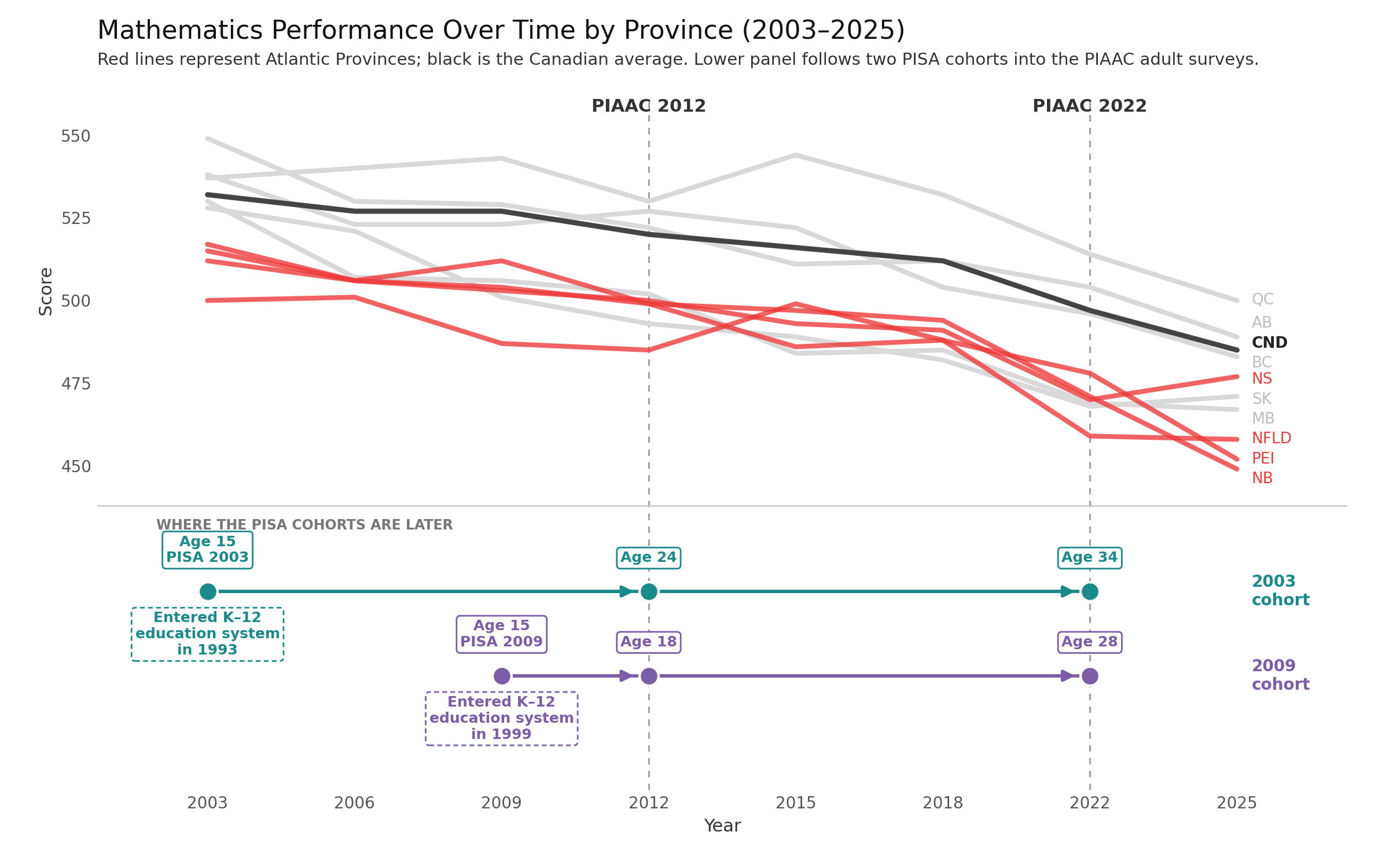
Figure 1. shows how we can connect PISA to PIAAC for comparison using pseudo-cohorts. While 34-year-olds in PIAAC 2022 are not the same individuals who participated in PISA 2003, they represent the same age cohort. We can use the PISA cohorts to track a group of people from when they started their journey in the education system in kindergarten, all the way into their adult careers.
Using these methods, PIAAC and PISA can be used together to understand a country’s relative skill performance. Analysis of this sort can reveal important insights that can identify how education systems at different periods of time can influence skill and work outcomes, which can then inform policy.
References
OECD (2024), Survey of Adult Skills – Reader’s Companion: 2023, OECD Skills Studies, OECD Publishing, Paris, https://doi.org/10.1787/3639d1e2-en.
OECD, 2025. From data to skills policy: How the Survey of Adult Skills Supports Policymaking.
OECD (2026), “Towards a stronger link between PISA and PIAAC: Two assessments, one story?”, OECD Education Working Papers, No. 349, OECD Publishing, Paris, https://doi.org/10.1787/95e96165-en.
Find different word