 English
ECEs
as Innovators

“Let’s try it out!”
ECE Professionals describe the impact of collaboration through the Lab.
Social Innovation in Atlantic Canada’s ECE Sector
ECE professional practice is highly compatible with the iterative test-and-learn cycles of innovation design. Every day, ECEs work with children in responsive, adaptive ways — trying out new ways to support their care and learning, gathering feedback from the children, and making adjustments to their environment and interactions.
Participants in the ECE Lab applied this iterative approach to the sector’s systemic challenges around recruitment and retention of the ECE workforce. They created eight social innovation prototypes that offer new ways of addressing these challenges. Supported by embedded design coaches, each prototype was field tested and refined, and now all prototypes are offered here for use by anyone in the ECE sector. A ninth prototype was developed in partnership with First Nations ECEs, and you can learn more about this groundbreaking work below.
Explore the insights and prototypes created in the Lab on this page. Then download a prototype action pack and try it out in your community.
What’s an innovation lab?
ECE Lab participants describe some of the prototypes they created in the Lab.
A social innovation lab is a convening of multi-sectoral interest holders to work on a complex challenge. Labs stimulate and support the development and testing of novel ideas that improve the outcomes on social and environmental issues. A process of trying out and adapting refines the most promising ideas and, along the way, labs also generate a deeper understanding of the systemic changes needed to effect change at scale.
Social innovation labs are considered successful when we see evidence of strong relationships developed between previously-siloed interest holders, new perspectives and insights on the problem are uncovered and shared widely, and potential new solutions emerge.
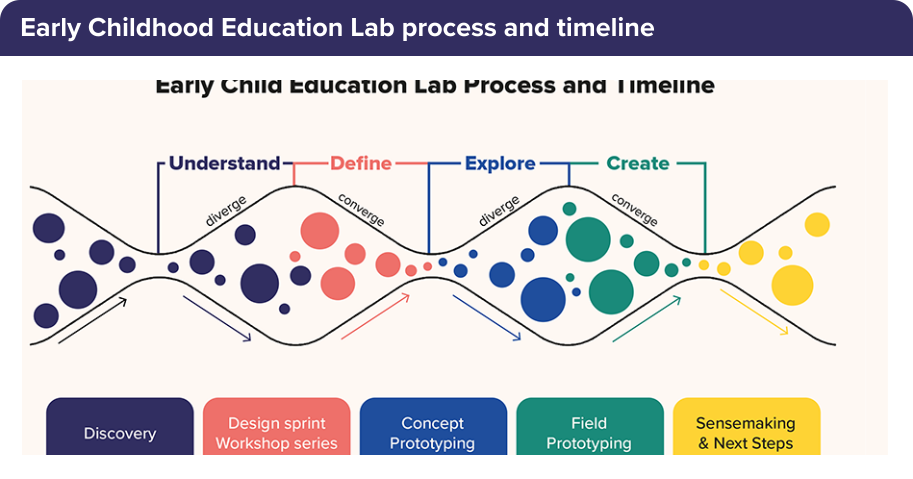
Social innovation labs are typically made up of five phases:


Solutions, Prototypes, Social Innovations: What’s the difference?
A solution is just that – an idea for something that solves a problem. Solutions to complex challenges, like the systemic conditions that can cause high turnover and undesirable working conditions in ECE, can take all kinds of forms. Sometimes they take the form of social innovations, or new ways of organizing people and resources to create new outcomes. In practice they can look like new government programs, new ways of working as a team at an early learning and care centre, new courses at a college or through a professional association, or new ECE community groups that gather to support each other’s learning and development.
In social innovation labs, we use prototypes to test out social innovations at a small scale to understand if we’re headed in the right direction. A prototype is a preliminary model of something from which other forms are developed. A prototype can be anything – a sketched-out version of a website, a flyer for a leadership program that doesn’t exist yet, a small one-time grant with a simple application process – anything that can represent an idea enough to be used by a few people, help us gather feedback, and generate learning about what will make our solution usable and effective.