
Clean Energy Through Transparent Innovation:
Rethinking Solar Integration for a Sustainable Built Environment
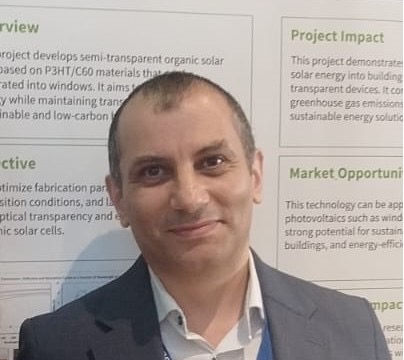
This blog is written by Bassel Abdel-Samad, PhD
Physics Professor at Université de Moncton
The global transition toward cleaner energy systems is no longer only an environmental necessity, it has become a technological and economic imperative. As governments, industries, and communities seek pathways toward decarbonization, the challenge is no longer simply generating renewable energy but integrating it intelligently into everyday infrastructure. In this context, transparent organic photovoltaic technologies represent a promising frontier where sustainability, functionality, and design converge.
At the intersection of materials science and renewable energy research, organic solar cells offer a fundamentally different approach to photovoltaic generation. Unlike conventional silicon-based systems, organic photovoltaic devices can be lightweight, flexible, transparent, and manufactured using low-temperature deposition techniques. These characteristics open the door to new applications, particularly in the growing field of building-integrated photovoltaics (BIPV), where windows and façades may eventually serve as energy-generating surfaces rather than passive architectural elements.
This is the challenge driving our current research on transparent organic photovoltaic cells. Rather than viewing transparency and energy efficiency as competing objectives, the project explores how both properties can be optimized simultaneously through precise control of fabrication parameters and thin-film engineering.
The work focuses on understanding how deposition conditions influence the optical and electrical behaviour of the device. Parameters such as active-layer choice, deposition method, and multi-junction-layer architecture are systematically varied to determine their impact on transparency, conductivity, and photovoltaic response. Thin films are fabricated using a combination of different deposition techniques, followed by extensive optical and electrical characterization.
What makes this research particularly meaningful is not only the pursuit of higher device performance, but the broader systems-level implications behind it. Buildings account for a significant portion of global energy consumption and greenhouse gas emissions. Integrating renewable energy generation directly into the built environment could fundamentally reshape how cities consume and produce electricity. Transparent solar technologies may contribute to this transformation by enabling energy production without sacrificing natural lighting, aesthetics, or architectural functionality.
Early experimental results already suggest encouraging directions. Optimized fabrication parameters and device configurations appear to provide a favorable balance between visible transparency and electrical performance. While further optimization remains necessary, these findings reinforce the viability of organic thin-film photovoltaics as adaptable solutions for sustainable infrastructure.
Beyond the laboratory, this work also reflects a broader shift in how innovation is approached in sustainability research. Clean-energy technologies are no longer evaluated solely through efficiency metrics; they are increasingly examined through their capacity for integration, scalability, accessibility, and long-term resilience. In this sense, material science becomes more than a technical discipline, it becomes a contributor to sustainable systems thinking.
For New Brunswick and Atlantic Canada, this research carries additional significance. Regional climate conditions, energy demands, and infrastructure realities require localized innovation strategies. Yet relatively little research has focused on the behaviour of transparent organic photovoltaic systems under these environmental conditions. By contributing experimental data and fabrication expertise in this area, the project aims to strengthen regional research capacity while supporting broader clean-energy objectives aligned with sustainable development priorities.
The future of renewable energy will not depend solely on producing more electricity, it will depend on how seamlessly energy generation can be integrated into the systems we already inhabit. Transparent and adaptable photovoltaic technologies offer one example of how innovation can move beyond isolated devices toward embedded sustainability within everyday life.
In that sense, the question is no longer whether buildings can produce energy. The question is how intelligently we design the materials that will allow them to do so.
On May 5, 2026, ResearchNB and the Fredericton Chamber of Commerce partnered with the Pond-Deshpande Centre to convene researchers at the forefront of clean energy innovation in New Brunswick. The panel at Planet Hatch spotlighted work in solar materials, nuclear systems safety, and smart building technologies — a reminder that Atlantic Canada’s energy transition is already underway, driven by researchers working right here in the region. Dr. Abdel-Samad was a panelist, and this research summary is one example of the thinking shaping that conversation. Follow the Pond-Deshpande Centre’s newsletter to stay connected to the ideas and people driving New Brunswick’s energy future.
