ECEs as Leaders

“Who me, a leader?”

ECE Leaders in Atlantic Canada have many names: Directors, Operators, Administrators, Home Childcare Providers, Pedagogical Leads – to name just a few. Some own their centres and employ many ECEs, others serve as Executive Directors of non-profit early learning and care organizations, and others operate out of their homes as solopreneurs. ECEs also serve as informal leaders through mentoring peers and students, and by participating in the collaborative leadership of their centre.

Regardless of the title, ECE leaders are knowledgeable and dedicated professionals who focus on serving their communities through providing reliable, high-quality early learning and care for children.

In 2022, as part of the second round of the ECE Lab, the lab team conducted interviews with 18 early learning centre operators, directors and administrators. The perpsectives offered by these leaders were combined with learning harvested from the interviews and prototypes conducted in the first round of the lab. Together, the data painted a detailed portrait of ECE leaders: what motivates them, the paths they take to leadership, and how they practice leadership in their roles — as managers, owners, pedagogical leads, peer leaders, and/or mentors.
Leaders at the heart of ECE operations

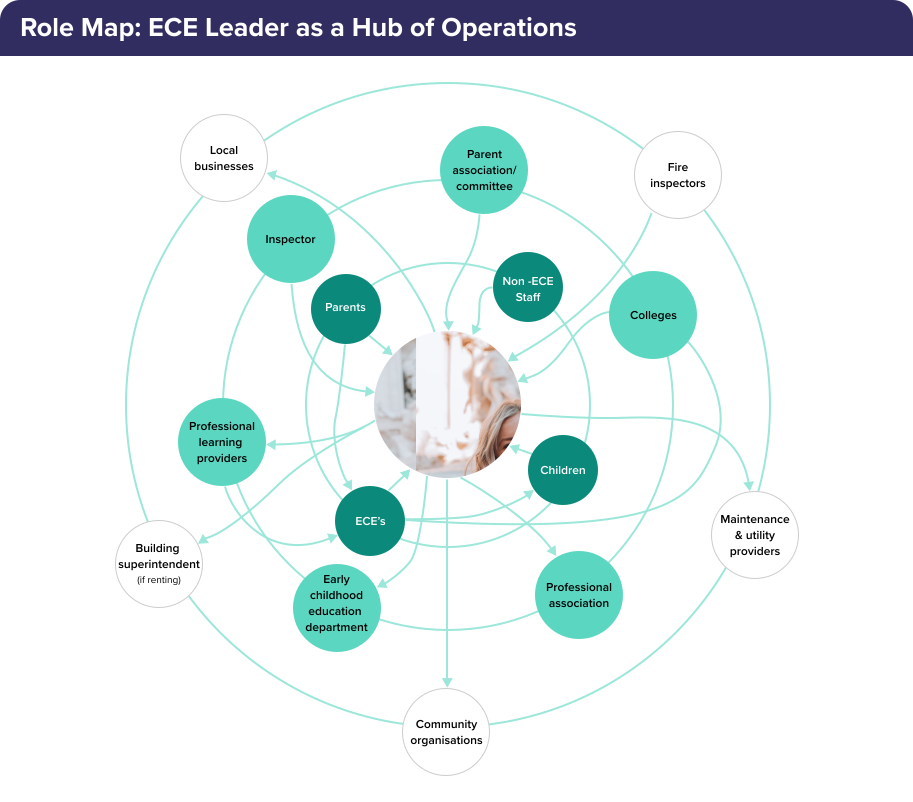
Responsibilities that ECE leaders carry span a wide diversity of roles, skills and subject areas. Children, parents and guardians, ECEs, and childcare staff such as cooks and cleaners rely daily on early learning centre operators, directors and administrators. Less visible are the ways that the sector and community rely on ECE leaders, including hosting practicum students, mentorship of peers and ECEs, reporting data to the province, consultation on ECE policy, active membership and service in their professional associations, community participation as a local business, providing transportation for children, and organizing compliance with health and safety regulations.
An ideal day as a leader

During the lab, leaders shared their visions of what an ideal day would look like in their jobs.

On an ideal day, I would probably to be in the office for three hours straight and uninterrupted, which is never the case. Usually it’s somebody needs something or somebody needs to be covered for 15 minutes. So it’s usually a lot of very interrupted work. I’d be in the office for three hours a day and more so on the floor for the other five of my eight hour day, just supervising and being a support to any of the educators if they have any questions or any needs or anything like that. I’d rather be on the floor with the children, but I find the office work takes up much of my time, especially when it’s constantly interrupted.

The ideal is really for it to be safe and welcoming, with staff who wake up in the morning and want to come to work. When they say “We are going to have a great day. I’m going to have a great day today,” because where they’re going, it’s welcoming, it’s warm, it’s attractive, it’s clean, and it’s safe.

…to have a little less red tape to fill out. But an ideal day for me would be to be on the floor, really with my educators, then with the children…

Our vision of being an ideal CPE is to be recognized as professionals by the school district, to be solidified, and to be part of the same team. We want to be active in the decisions schools make, such as last minute closures. That’s a lot of last minute closings. You always have to find who will come to work in the morning to cover the school daycare.

I really see my role as how I can help the employee or how I can make sure the employee has everything they need to do their job. That’s really my job, it’s to make sure that employees have everything they need in terms of equipment, resources, that they have children, that they have information about children, contact with my parents. So that’s really my ideal day, where I can accompany my employees in their work.

My ideal workday honestly would allow me to have more dedicated time in the classroom unless educators are out or need me to step in. Really, I only get about that first hour to two hours to be observing what’s going on and getting live feedback from how this center’s operating.

…And the reality

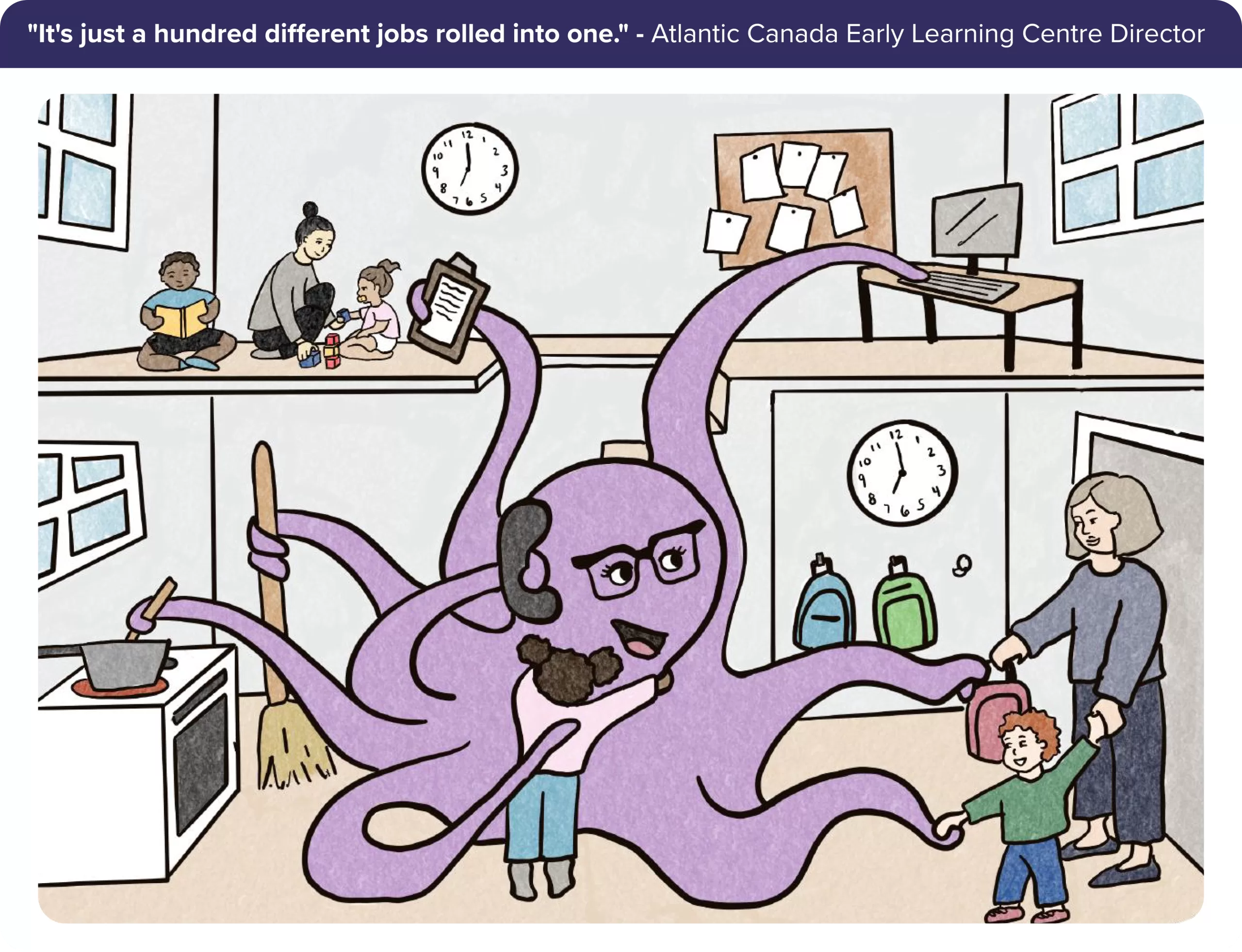
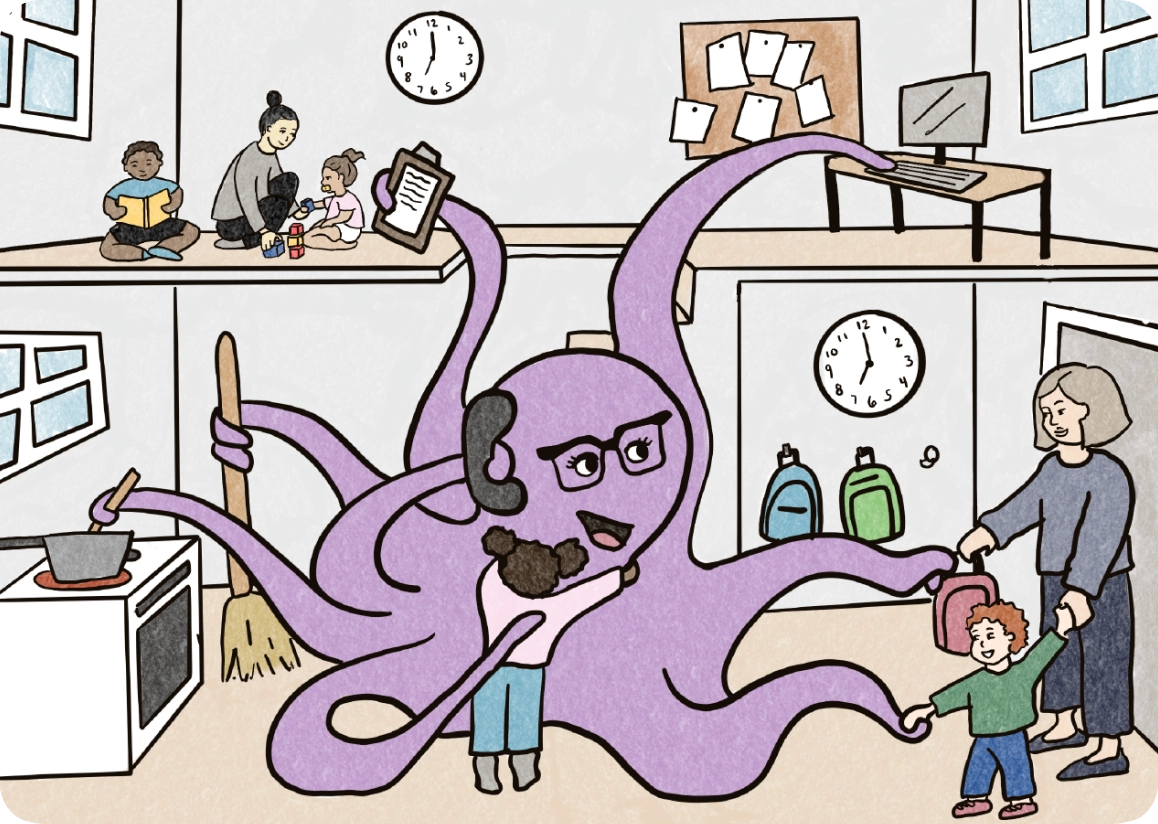
Leaders’ reports of the many and varied responsibilities they hold gave rise to the ECE octopus, a metaphor warmly embraced by the sector to express the multi-tasking balancing act that is required in the role of an ECE leader.

Breakdown of an ECE Leader’s responsibilities

Operator as Administrator

Paperwork for government/managing inspections/licensing process

Recruitment/HR/onboarding new staff/payroll

Managing enrolment/intake/wait list

Managing staff ratio requirements/finding subs

Purchase of furniture/equipment/toys/books

Applying for government grants and supports

Operator as Operational Glue

Driving the school bus (for those with bus license)

Greeting parents and students in the morning / accueil

Managing / maintaining building

Cooking for children (for those with food safety license)

Operator as Information Hub

Communicating with parents (phone, email, in person)

Communicating with community partners for activities and events

Working with the parent’s board/committee

Communication with the government

Working with the board (non-profit)

Liaising with the association/community of practice

Operator as Mentor-Educator

Creating an engaging learning environment

Developing the staff/ PD and training

Going into ratio when one of the staff calls in sick and there’s no sub/floater

Mentoring staff/classroom supervision and support

Creating cultural programming

Keeping up with latest updates in the sector

Hanging out with the children