Blog Post
This blog was authored by Dr. Simon Marmura Brown, Strategic Director, UNB’s Pond-Deshpande Centre
The Forgotten Coast
A reflection on sustainable tourism, the Saltwind Foundation, and what place-based development really looks like on Newfoundland’s southwest coast.
There’s a stretch of Newfoundland’s southwest coast that people call the forgotten coast and it isn’t hard to understand why. The communities there: Burgeo, Ramea, François, and Grey River, are some of the most remote in Atlantic Canada, reachable by a long, winding drive and, for three of them, reachable only by boat. For decades, as fisheries have declined and young people moved away, these towns have slipped quietly out of conversation and memory.
Last week I was invited to spend a few days there to take part in a roundtable with people working to change that, and I came away more convinced than ever that forgotten is not the same as finished.
A little over a year ago the PDC was contracted by the Atlantic Salmon Federation to write a report supporting place-based prosperity in southwest Newfoundland. In it, I charted a tentative path forward for the region based on what we heard: a path built on sustainable, conservation-based tourism rather than on industrial aquaculture. The southwest coast is home to irreplaceable ecosystems: bays and fjords that sustain whales, wild Atlantic salmon, seabirds, eelgrass, kelp, and other flora and fauna too numerous to name. These are vital ecosystems, unique in North America. A coalition of citizens, municipal, provincial, federal, and Indigenous leaders, NGOs, and members of the philanthropic and research communities had come together to protect them with a recognition that protection alone wasn’t enough. These communities also, urgently, need to create economic opportunity.
The report tried to hold those two goals together: conserving the ecosystem and fostering prosperity. It highlighted what makes the region singular. It looked at other places that have pursued place-based, conservation-driven development like Fogo Island and the area surrounding Gros Morne National Park, and what their journeys and timelines looked like. It made the case for the Saltwind Foundation, working to provide resources such as capital and other forms of assistance, so that these communities can draw on to build tourism capacity: to cut trails, upgrade marinas, create visitor centres and signage, and more. The report also sketched a ten-year plan for getting from point A to point B. Point A is forgotten and Point B is remembered, visited, appreciated, and cherished, not only by the people who live there, but by people from all over the world.
Last week I had the opportunity to see it for myself and participate in those conversations about building prosperity southwest Newfoundland. I flew into Deer Lake, picked up a rental car, and headed towards the coast on three and a half hours of winding, solitary, highway.
At a certain point you leave the Trans-Canada and turn onto a smaller highway through thick forest. Eventually, the trees break and you’re struck by a landscape that has been clawed and scraped by glaciers: little pools and ponds scattered across rocky, tundra-like terrain, mountains, and rolling hills. After about an hour of that, you see the ocean.
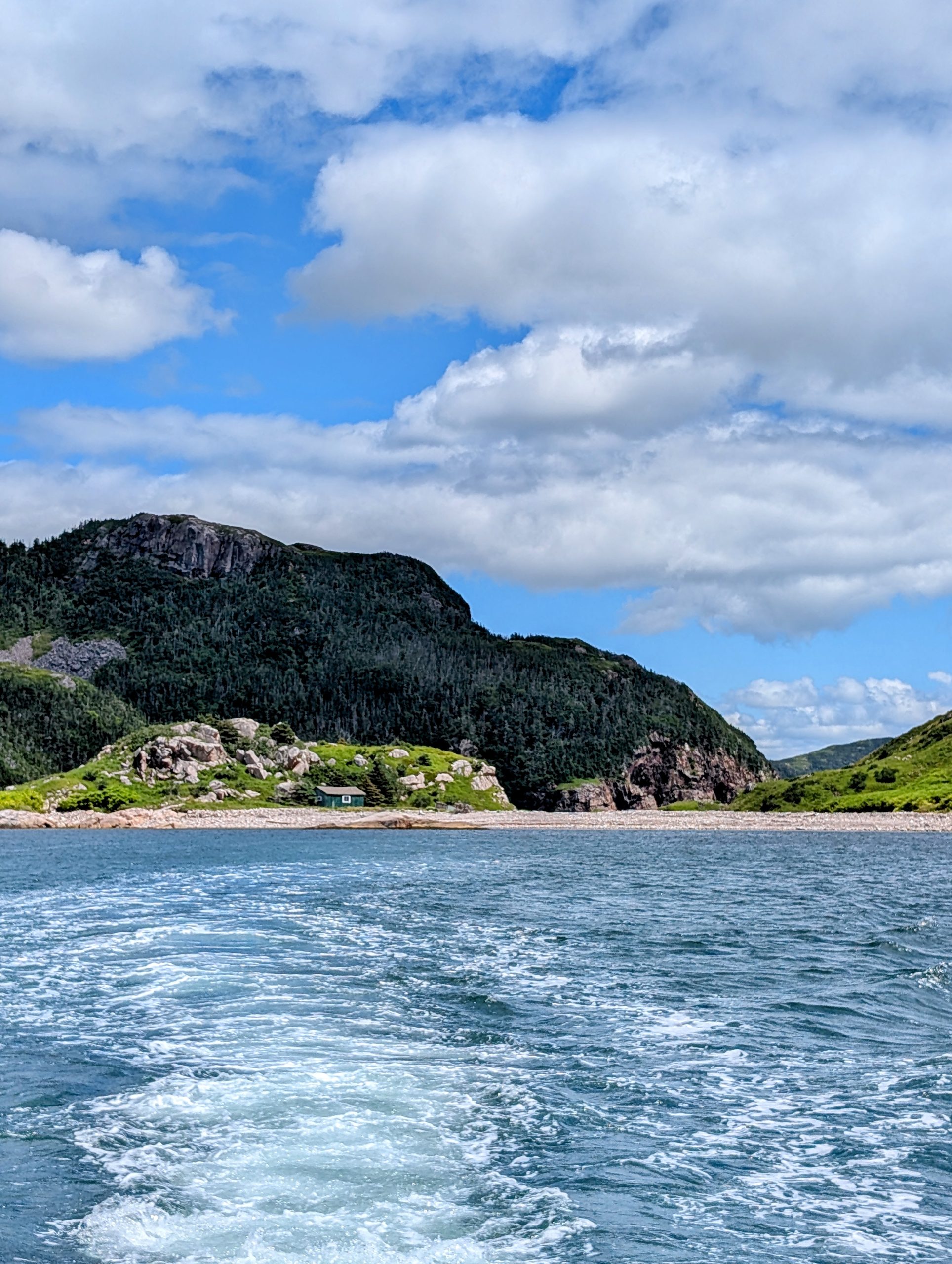
The next day, out on a small boat, I was able to witness the fjords I had written about: towering cliffs, coves and islands, and clear, cold, nutrient-dense water. I got off the boat more certain than ever that this is a place worth preserving, and a place worth visiting.
The roundtable itself was a day set aside for people whose livelihood, inheritance and history are tied to these communities and, together with experts and consultants, we came together to deliberate. A structured agenda of presentations from range of people: community leaders, provincial officials from economic development and tourism. There were entrepreneurs from Gros Morne and Corner Brook who have built businesses on these types of place-based tourism. There were Indigenous rights-holders, who have an immemorial and sacred ties to the lands, NGOs, wildlife conservationists, trail builders, and researchers, alongside the staff of the Saltwind Foundation and, most importantly, members of the communities themselves. The purpose was simple but not easy: to spend a day taking stock of what’s already being done, to deliberate over what could be done, and to identify the future these communities want.

That work didn’t begin with the roundtable. Before I arrived, town halls had been held in all four communities. In François—a town of fewer than sixty people—more people turned out for the town hall than live in the town. That detail has stayed with me. People here care deeply about where they live, and they sense that they’re standing at a generational inflection point.
What I witnessed over those few days was something I don’t often get to see up close: a real, working example of how place-based economic development is supposed to unfold. To me, place-based prosperity means that the benefits of investment and growth accrue first to the people who live in a community. It reminded me of a simple, though demanding premise I learned in Art of Hosting training this past spring: there is wisdom in the room. Instead of arriving with a finished plan and trying to sell it, you convene people, especially people who know the place best. You follow a process and ask questions where you truly listen, rather than rushing to answers and, in so doing, you create the conditions for a community chart its own way forward.

On the southwest coast, the work has already begun. Trails are being surveyed. Marinas are being upgraded. Conversations are underway across every level of government. NGOs are providing seed funding. Foundations have been established. Proposals are being read and written.
What’s hardest to put into words is how powerful it is to watch a diverse group of people come together, deliberate from the bottom up about the kind of development they want and the kind of community they want to live in, and then set about making it happen.
This, in many ways, is exactly the work we set out to do at the Pond-Deshpande Centre. Place-based prosperity, fostering systems change, and working alongside communities to build prosperity that works for them, on their own terms, is at the core of our mandate. The southwest coast of Newfoundland is a chance to watch that mandate come to life.
You can read the report here, and check out Saltwinds to follow their work in the region as it progresses.


Follow Along
If you’re interested in following this and our other work accelerating systems change for place-based prosperity, you can subscribe to receive updates in our newsletter.
